Showing posts with label nonprofit. Show all posts

Saturday, December 14, 2019

Regarding Diversity Nonprofit Boards

When talking about diversity and nonprofit boards, if you reference and/or share nothing else, here are 4 quotes and sources I recommend anchor any conversation you have.
Having a board with diverse perspectives is critically important. Each person will bring his or her own personal and professional contacts and life experiences to their service on a nonprofit board. With a diversity of experience, expertise, and perspectives, a nonprofit is in a stronger position to plan for the future, manage risk, make prudent decisions, and take full advantage of opportunities. A diverse board that is also sensitive to cultural differences is usually one that has a stronger capacity to attract and retain talented board members - as well as to be in touch with community needs. 
 - Diversity on Nonprofit Boards, National Council of Nonprofits
---
As stewards of the public good, all social sector organizations, regardless of mission, are called on to embrace and celebrate our common humanity, and the inherent worth of all people. In doing so, we must also acknowledge that a climate of growing intolerance and inequity is a challenge to our democratic values and ideals. Divisions along economic, racial, religious, and political lines have created an increasingly polarized society in need of healing. And the complex issues and dynamics at the intersection of race, class, gender, and sexuality call for deeper thinking as we seek to understand each other. 
 - Diversity, Inclusion, & Equity, BoardSource
---
Although nonprofit board members are aware of the importance of diversity and inclusion, they lack the knowledge, skills, resources, and commitment needed to turn that awareness into action, a report from executive recruiting firm Koya Leadership Partners argues. Based on an online survey of board or executive committee members at more than a hundred nonprofits, the report, The Governance Gap: Examining Diversity and Equity in Nonprofit Boards of Directors (42 pages, PDF), found a significant gap between respondents' intention to increase diversity and the actions they've taken to do so. 
 - Report Urges Nonprofit Boards to Turn Diversity Awareness Into Action, Philanthropy News Digest 
---
Whether we like it or not, nonprofit and foundation boards wield a tremendous amount of influence on this work. And whether we intend to or not, the lack of board diversity trickles down and has some wide-ranging consequences...Because of the self-reinforcing cycle, mostly-white boards are likelier to hire white EDs/CEOs, who then are likelier to hire white staff, so now there’s lack of staff diversity in the sector as well. 
 - 7 Things You Can Do to Improve the Sad, Pathetic State of Board Diversity, Nonprofit AF


Tuesday, December 08, 2015

It's freak-out-o-clock with nonprofit leadership


"Leaders don’t have time to do their jobs: A huge weakness of our sector is that we are turning brilliant leaders into brilliant fundraisers. Development is an essential element of our work, and some of the smartest and most talented professionals in our sector are fundraisers, but the balance is off. All of us are spending more and more of our time and energy freaking out about money instead of working with our teams to think about systemic issues and collaborating."

That's just one of a number of great points made by Vu Le, blogger behind Nonprofit with Balls. Read the full piece here.

Thursday, November 20, 2014

Grantmaker resources, working in the DC arts scene

Hey there,

Just a quick share about three resources for grantmakers which we take advantage of, at the DC Commission on the Arts and Humanities:

Washington Regional Association of Grantmakers:

  • "The Washington Regional Association of Grantmakers is a membership association composed of grantmakers in the Greater Washington region - Northern Virginia, suburban Maryland, and the District of Columbia. Our members represent a vibrant cross-section of philanthropy, including family, community, corporate, and independent foundations, as well as corporate giving programs, governmental grantmakers, grantmaking public charities, and individual philanthropists. We provide a variety of services to our members to facilitate more effective, strategic, and efficient grantmaking, thereby making the Greater Washington region a better place to live and work."


Grantmakers in the Arts

  • "The mission of Grantmakers in the Arts (GIA) is to provide leadership and service to advance the use of philanthropic resources on behalf of arts and culture. GIA is the only national association of private and public funders making grants to artists and arts organizations in America. GIA’s strength is in its diversity of members: private, family, community and corporate foundations, national, state and local governmental agencies, nonprofit national, regional and local service organizations. What they all have in common is a belief that America is a better place to live and our communities are stronger when the creativity of artists is prevalent in all aspects of society."


  • "For more than 15 years the GEO community has advanced smarter grantmaking practices that enable nonprofits to grow stronger and more effective. As a result, GEO members consistently outpace other funders in terms of making productive changes to help nonprofits achieve more — such as providing support for grantee capacity building, engaging external voices in decision-making, giving multiyear grants, forming strategic partnerships and funding collaboration among grantees."


Just thought I'd share, for any other grantmakers out there, hopefully you'll find at least one of these useful, if you're not already a member.

And as new members to the latter two, I'm looking forward to taking advantage of their programs and learning more.

Any other similar organizations you'd recommend? Please share in the comments!!

JR

Saturday, March 29, 2014

Term limits: Worth it or worthless?

Hey there,

So in a number of various situations, term limits is one of those given circumstances to any nonprofit governance situation, particularly arts nonprofits. But for the purpose of this particular post, I am referring to term limits regarding nonprofit board governance, not for-profit, and not elected government officials, which isn't to say that the conversation isn't at least related.

And to answer my own question before you've even read the rest of this blog, I would say it depends. That being said, I put the question out there and received some replies I wanted to share from colleagues.

Here's a reply I received on Twitter from Jess Solomon (thank you!!):
And if you'd like to see the the responses my inquiry received on Facebook, well, check out the post here:


So as not to rely solely on anecdote and personal experience, although all those who replied are professionals whose input I certainly appreciate, respect, and recommend, I Google'ed "nonprofit governance term limits" and thought I'd highlight excerpts from some of the results on the first several pages.

From On Board For Term Limits, The NonProfit Times, 10/1/11:
The Internal Revenue Service (IRS) has endorsed term limits, according to Bruce Hopkins, a partner in the Kansas City, Kan., law firm of Polsinelli Shalton Flanigan Suelthaus. “It’s certainly recommended in many quarters, but there’s ongoing debate whether it’s appropriate or not. Limits can force new blood on a board, which can be a good thing but sometimes organizations lose people who are competent, who can serve and want to serve, but can’t. There’s a valid debate on both sides of the issue,” Hopkins said.
From Five Reasons Board Leaders Should Have Term Limits, The Chronicle of Philanthropy, 1/18/11, specifically having to do with a Board Chair's term limit:
Term limits provide a painless way for people who aren’t doing a good job to retire gracefully and automatically. Admittedly, this is a pragmatic argument—and the downside is that a chair who is doing a fantastic job may get forced out early. But I’ve never heard a real-life complaint about term limits. And I’ve heard many complaints about their absence. 
And from Principles for Good Governance and Ethical Practice, Independent Sector, regarding the core concepts of "Principle 17: Board Member Term Limits":
  • Term limits provide natural turnover on the board. 
  • Staggered term limits prevent the entire board from changing at the same time, providing a way to preserve institutional memory. 
  • Term limits should be enforced in a systematic manner.
One quote from Alyson Ball, President of BoardWorks, LLC, from Term Limits - Critical to Your Nonprofit Board's Success:
Term limits are critical to a board's health because they prevent a single individual or group from monopolizing the spirit of the organization. They ensure that new ideas and approaches are explored - something that's essential to the success of every organization. Everyone is forced off the board eventually. If your board doesn't have term limits, I recommend you start thinking about them now.
And in conversations I've had, the main argument against term limits seems to be worry about loosing great board members, particularly regarding institutional knowledge. But that seems to be more a matter of engagement rather than governance.

But it's all related, because if you don't have a robust process for recruiting and onboarding new board members, of course one would be worried about loosing current ones.

Regarding the institutional knowledge, that not only seems to be more about how new members are onboarded, but also resides largely in the domain of the staff, more so than the board members, who are on the ground working Monday through Friday, 9 to 5, and often times more.

But again, the best answer is "It depends", because this is not a one-size-fits-all kind of question. With that being said, what is your own experience, and where along the spectrum of "Worth it" to "Worthless" would you say term limits lie for you?

- JR

Thursday, November 07, 2013

Amazon Smile: Online shopping for Nonprofits

Amazon is giving folks another reason to smile. Haven't heard about AmazonSmile yet?
AmazonSmile is a simple and automatic way for you to support your favorite charitable organization every time you shop, at no cost to you. When you shop at smile.amazon.com, you’ll find the exact same low prices, vast selection and convenient shopping experience as Amazon.com, with the added bonus that Amazon will donate a portion of the purchase price to your favorite charitable organization. You can choose from nearly one million organizations to support.

You might have noticed if you looked closely that in the screenshot above, it says that 0.5% of my purchases will go to the Foundation Center. This is because a Foundation Center post is how I found out about it.


So, if you want, you can select another charitable organization.


You can even search by name, location, or keyword, which I did for "Washington, DC".


It gave me over 8,000 results in the DC area.

And if you're an organization, you can register here.


To do so, the site first asks you to find your charitable organization. It also states, "you must be an authorized representative of the organization."

There've already been a number of articles written about this, offering different bits of context and insight.
The high-level message is clear: Amazon wants people to know it cares about people and communities. But there’s an underlying message that seems just as apparent: we’ll keep giving as long as you keep buying. (read more at TechCrunch)
 "AmazonSmile allows us to reach millions of existing and new supporters who can help us find cures for cancer and save children," said Richard Shadyac Jr., CEO of ALSAC/St. Jude Children's Research Hospital. "At St. Jude, we're leading the way the world understands, treats and defeats childhood cancer while ensuring no family ever receives a bill from St. Jude for treatment, travel, housing or food. Working with AmazonSmile gives us a new way to support our mission that's simple for both us and our supporters." (read more at the Wall Street Journal)
So...what do you think? For those who use Amazon regularly, do you think you will take advantage of this
philanthropic option as a consumer?

Leave your thoughts in a comment below!!


Saturday, January 12, 2013

Great Charity Happy Hour for SMYAL last night

Hey there,

 So I went to my first Meetup last night. Ever.

I'd been on the site for years, but then this one came long, and I thought why not.

It was hosted by the 20s & 30s Going Out Group at Ultrabar, right at 9th & F St, NW.


And it was a charity happy hour, of which 80% of the donations collected were going to SMYAL, the Sexual Minority Youth Assistance League here in DC, an organization for LGBT youth, of which I am actually an alumn.


It was a well attended event, and a great mix of folk, both 1st timers to the group, and veterans. Met a handful of people working on PhD's, as well as some tax folk, and IT people. I was the token arts & nonprofit person, it seemed, representing, which was fun. I even met someone who works at the International Spy Museum and knew a friend of mine who just started there, working with their media.

Small world, right?

It seems like most of the people in attendance were just looking to meet fresh faces, as well as find things to do. So as a SpeakeasyDC board member, I did my due diligence and suggested they check out our monthly open mic at Town Danceboutique. And, yes, I had brought our cards with me, just in case the need arose. And it did.


Speaking of board members doing their due diligence, as I was leaving and just about at the door, I was stopped by a member of SMYAL's Board of Directors, Billy Feitweis. He had actually recognized me from seeing a tweet of mine which @SMYALDC retweeted, about going to the event.
I obviously appreciated that he took the time to say hello and connect. And I especially love that it happened because of social media!!

So yeah good people, good cause, good times. Hoping to catch up with the new friends I made last night, as well as looking forward to the next 20's & 30's Going Out Group event. What's especially great is that even though it says 20's & 30's, a regular attendee told me that it clarified it on the website, that the group was for people who were, or simply still felt like they were in their 20's & 30's.

Which is good...I was afraid I only had 8 more years of being involved. And hey, if you're in the DC area, maybe I'll see you at an event soon,

- JR

Tuesday, January 08, 2013

Foundation Center classes and the return of Big Duck

Hey there,

So I was in a Fundraising committee meeting for SpeakeasyDC last night (of which I am a board member), and one of my fellow board members mentioned wanting to take advantage of the resources of the Foundation Center's location in Washington DC.

It's been a while since I've been, but they have a regular schedule of classes and trainings, many of which are free. You can check out their calendar here.

And before the night was over, I signed up for several of them. The first two are ones that they provide regularly (one of which is tomorrow and they still had space for!!), and the third one is a special program:
What I love about that last one, other than the Valentine's day themed title, is that the guest presenter is Farra  Trompeter, VP of Big Duck. My first experience with Big Duck was also at the Foundation Center DC last September, and it was with Principal and Founder, Sarah Durham.

You check out select tweets from that workshop on Brandraising, a model Big Duck developed, storified here. After that, I posted at my Hashtag the Arts blog, my top ten takeaways from it. This also informed a piece I wrote as prep for an #ArtsMgtChat I was hosting, Your Artists on Social Media: An Essential Part of Brandraising.

Needless to say, I'm a fan, and am grateful for the perspective I was introduced to, and am VERY excited to attend this class with Ms. Trompeter. And if you're free and available, I would highly recommend you register and sign up for it as well.

Wondering if you should attend? They recommend the following attend:
Nonprofit executive, communications, development, board members, or marketing staff. This workshop will be most helpful if you have an existing list of supporters, a website that can process donations, a database for tracking contributions, and a system for sending email blasts.
Definitely check out the class page for more info, including what you'll get from the workshop. And hopefully see you there, either for some donor love or either of the other classes.

JR

Sunday, August 19, 2012

SXSW panels I recommend checking out

Hey there,

So I wanted to share some panels that have come up in my FB feed and twitter stream, proposals for next year's SXSW Interactive. If you're not familiar, here's a blurb from their page:
The 20th annual SXSW Interactive Festival will take place March 8-12, 2013 in Austin, Texas. An incubator of cutting-edge technologies and digital creativity, the event features five days of compelling presentations from the brightest minds in emerging technology, scores of exciting networking events hosted by industry leaders and an unbeatable line-up of special programs showcasing the best new websites, video games and startup ideas the community has to offer

Let me just point out that the following highlighted panels are not the result of any comprehensive vetting process. They are mostly people, and in one case an organization, that I've been fortunate enough to connect with in person.

That being said, I'm not receiving any compensation from any of of the people or organizations I mention below.

I also don't believe in coincidence, and I'm grateful to know those I've crossed paths with. Because people, in general, are up to amazing things.  With that, here are some panels I recommend checking out.

Education
  • Minerva Project & 2tor CEOs: Future of Higher Ed - "Higher education is transforming before our eyes. Universities and colleges are under increasing pressure to stay relevant during the current digital revolution. But with a plethora of options, ranging from...(read more)"
  • College Vs. UnCollege: Are Degrees Worth It? - "In the Information Age, where knowledge has become ubiquitously accessible and informal education courses and certificates have blossomed, do formal college degrees still offer enough...(read more)"
  • My connection - I sing with a guy who works at 2tor, a company which has a representative on each panel proposed. You can check them out at their website previously linked, or also on Facebook.
Health, health care, and patient advocacy
  • Crowds for Care - "Who Controls what new drugs, treatments, and tech will emerge to improve care? Until now, the answer was only giant corporations and government committees because they control the funding. In July 2012, Patients and Doctors began funding the healthcare innovations that they care about through Crowdfunding, creating a huge wave of support that the corporations and government love because...(read more)"
  • My connection - Regina Holliday, she is one of the speakers on the panel. I met this wonderful woman at the first Social Justice Camp DC. In a related note, if you'd like to see the FB note I posted after the first night of this event, you can check it out here. You can found out more about her at her blog, as well as follow her on Twitter, and connect with her on Facebook. I encourage you to do any, if not all, of the above.
Nonprofits & social media
  • We <3 Social Data! But What Do We Do With It? - "Lots of nonprofits are buying social data, giving them an unprecedented amount of information about individual supporters. But once you have it, what do you do with it?" (Read more)
  • My connection - one of the panelists is with Small Act, who's tag line really sums up what they do, "Make a big impact in social media". I've gone to a couple of free trainings at the Foundation Center in DC, led by a small act employee, the wonderful Annie Lynsen who's position is Director of Awesomeness. And awesome is what anything they're involved with is guaranteed to be. You can follow them on Twitter and like them on Facebook.
Theatre
  • Smooth Scrum: Lessons from the Theatre - "The last few decades of the American theater have seen a rapid growth in the number of ‘devising ensembles’—playwrights, actors, directors, and designers working together in collaborative groups to develop plays. It's agile development for the American stage. Instead of beginning with a script...(read more)
  • Here's a video embedded on the proposal page:
  • My connection - This is actually a second degree one, but the DC Theatre community is small like that, which I love. When I put it out on Twitter that I would be blogging about this, a fellow DC artist, friend, and social media rockstar, Chelsey (aka @chelseydc) tweeted back
     And I did. Well, Gwydion actually got to me first, and let me know about his proposal, which I promptly found and voted for. You can follow him on Twitter.
So there's that. I hope this helps you sift through the multitude of proposals if you've been in it, and if not, I hope this is a good start. And if there's any that you're involved with or support, certainly share them in the comments. But don't just copy & paste the link. At least say a little bit about how you're involved or connected.

And for any other friends who have proposals, let me know. Also, I want to go!! If anyone is looking to have someone help out and work with their social media presence before and during, hit me up :-)

- JR

Tuesday, July 24, 2012

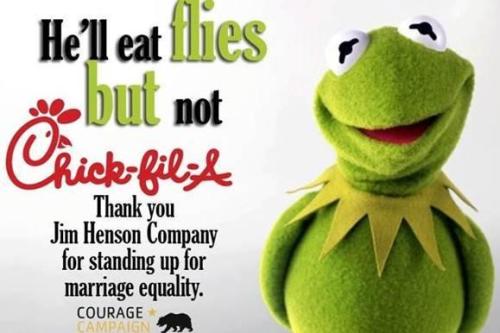
Chik-fil-A's LGBT stance: Business & politics collide


A visual meme from
the Courage Campaign
You've probably heard about it by now.

"The Muppets have filed for divorce from Chick-fil-A citing irreconcilable differences" (thank you, Ricky!!).  And just in case you haven't, or even if you have,  Jezebel has a great piece on it, "Muppets and Homophobes Locked in Fierce Battle Over Chick-fil-A":
Last week, Chick-fil-A's CEO confirmed what liberal fun-ruiners already knew — the restaurant not only serves up delicious waffle fries, but also some good old fashioned from-scratch bigoted homophobia. Like Mom used to make! (read more...)
This caused the Muppets, via the Jim Henson Company, specifically their Facebook page, to assert their own stance on the matter:
A parody of
Chick-fil-A's catchphrase 

The Jim Henson Company has celebrated and embraced diversity and inclusiveness for over fifty years and we have notified Chick-Fil-A that we do not wish to partner with them on any future endeavors. Lisa Henson, our CEO is personally a strong supporter of gay marriage and has directed us to donate the payment we received from Chick-Fil-A to GLAAD. (http://www.glaad.org/)
If you're on Facebook, you can go here to see the note. As of the time of this post, the note has had almost 12,000 likes, roughly 5,600 shares, and over 2,500 comments, mostly positive and supportive. And as you can see from the images posted, it's inspired a number of visual memes shared via social media.

The divorce also inspired calls for a boycott of Chick-fil-A from the LGBT community and its allies, but als a day of support from those who consider themselves stewards of the "traditional family".

The Atlantic posted an interesting opinion piece, addressing the call to boycott,  "In Defense of Eating at Chick-fil-A" which kicks off the article by asking, seemingly rhetorically:
Do we really want a country where people won't do commerce with those who have beliefs different than their own? (read more...)
I consider myself a man of logic, and for the most part, I could follow the author's point, and agreed with certain aspects of it. Until he stopped short of seeing his argument out to fruition. While I can empathize with his feelings about the knee-jerk reaction to scream "boycott" in a crowded theatre when you realize a company you've supported doesn't support you, to me this causal relationship, this flow of money can't be ignored.

Because I'd rather be part of a society where we might feel the desire to boycott more than we need to, versus one that encourages a culture of consuming without considering consequence and not speaking up against discrimination.

There is always consequence where profit is concerned. In fact I would say that it's actually hypocritical to claim that you treat every customer with "honor, dignity and respect", when as soon as you have the money of your LGBT customers you spend it on policies and rhetoric that causes harm to them. It's as if to say they're only your customers at the time of purchase.

And to encourage people to spend blindly, without thought for what business owners spend their profits on, when it's spent on organizations that affect others' lives for better or worse...I would say that is the worst trait of consumer culture.

On the flip-side you have Boston's Mayor, Mayor Thomas M. Menino, who has vowed to keep the franchise out of his city. Time has a piece on this, "Boston Mayor Blocks Chick-fil-A Franchise from City over Homophobic Attitude":
"You can’t have a business in the city of Boston that discriminates against the population. We’re an open city, we’re a city that’s at the forefront of inclusion." (read more...)
What it comes down to is corporate philanthropy. Grantspace has a page answering the question "Where can I find information on corporate giving?"

And it's the realization on the part of businesses and corporations that what they do with their profits can encourage or discourage consumption of their product. Anything that goes to something other than their own personal pursuit of happiness and begins to affect others is up for scrutiny. While most corporations have acknowledged this to some extent, it seems Chick-fil-A believes that their consumers and the causes their profit support exist in two different worlds.

Hopefully this will be a wake-up call for them as similar issues have been for others companies and even non-profits, teaching that eternal and universal lesson, with every action comes an equal and opposite reaction.

This is a bad thing when that action works against and excludes people. And a good thing when the action works with and includes others.

Divided, we fall, and all. Obviously, all this is just my opinion and based on personal experience. Would love to hear what others think, even if, especially if it's a different point of view, as long as it's constructive and respectful.

- JR

Monday, July 23, 2012

Two social media books have shipped!!

So first off, curse you Amazon!! For making it so easy to find and order things.

*sigh*

Okay, now that I've got that out of the way, I'm REALLY excited for these two books I ordered. I received the emails last night saying that they have been shipped.

One book is titled Social Media for Social Good: A How-to Guide for Nonprofits. Published in August of 20122, its description on Amazon is:
Based on more than 15 years of experience in nonprofit communications and 15,000+ hours spent utilizing social and mobile media, Social Media for Social Good: A How-To Guide for Nonprofits is a comprehensive 256-page hardcover book packed with...(read more)
Heather Mansfield is the author and is one of the main individuals involved with one of my go-to website on social media advice and references for nonprofits, Nonprofit Tech 2.0: A Social Media Guide for Nonprofits.

DEFINITELY check out their website and connect with 'em on any of the 10 social networks they've got linked on their home page and/or email as well as SMS.

For my second order, the book is Social Media Tactics for Nonprofits. It was published a bit more recently than the title above, in February of this year, and its description reads:
101 Social Media Tactics for Nonprofits features 101 actionable tactics that nonprofits can start using today, and most of the featured resources are free. Broken down into five key areas, this unique guide explains the steps and tools needed to... (read more)
While I'm not familiar with either of the co-authors, I did recognize the contributor of the foreword, Beth Kanter. With regard to not recognizing the others, I chalk that up to how much I'm still dipping my toes in the social media pool, rather than it being any reflection of their own presence or authority. Besides, I got the book, right? And seeing Beth Kanter's name was just icing on the cake.

You can keep up with her by checking out her website and connecting on any of the 6 social networks she's linked on her home page, as well as by rss feed.

But I digress. I'm personally a fan of books (and I not-so-secretly want to start a Social Media Book/Reading Club). And when it comes to social media, a friend brought up a concern of how dynamic the platforms are in terms of updates and format changes and any other number of things to keep up with. The question became, how useful are books like this if the subject they're referring to has  changed by the time the book is published, much less referred back to months or years down the road.

While this might be true, I believe that when it comes to overall strategy and tactics like what is addressed in the books I've ordered, I believe that they can and will still be relevant regardless of how the various social networks might evolve and manifest.

So that being said, if anyone else thinks they might join me in adding to these titles to their library, or already have, please be in touch!! And if you have any other books you'd recommend, then definitely do so.

- JR

Wednesday, April 25, 2012

10 things done wrong on Social Media

Hey there,

I posted this link Idealware shared, 10 Things You're Doing Wrong on Social Media and just wanted to share some thoughts I had posted on Facebook.

Personally, I would say numbers 4, 6, & 7 are the top three consistent issues I've observed...Would be curious to see how much others have observed the other issues listed?

And for my fellow social media managers, which ones are your biggest challenges, and what're you going to do to address it?

A friend asked what to do about fans/followers who get most of their organization's content via social media, but miss most of the updates because they don't check it at work.

To them I said I would personally recommend using Hootsuite or another program, to schedule social media updates when your fans/followers are not at work, and more likely to be on social media. If you know the bulk of your fans/followers don't log on during the day, then don't schedule most of your status updates during the day.

Also, from what I've seen, that's where various media related to your main post come in handy. If you're updating them on an upcoming show, share a different pic each time but still (if on FB) with the link to your event page. It's not that the goal can't be the same, just make sure you're switching up the content of the message.

Ah, I remember the sentence that really made the light bulb go off, and I know it's a bit of a Captain Obvious thing, but I heard someone say in a webinar, when posting for your org:

"Don't post when you're on social media, post when your audience is on it".

That's why most of the posts I do for my org during the day tend to be content for other arts organizations, artists, and nonprofits, then evenings and weekends are more for the people we work with and the public we bring our artists to :-)

- JR

Thursday, March 15, 2012

Techsoup on Facebook Timeline, and visual power

Hey,

So there's a really GREAT blog by Susan Chavez on Techsoup which was posted in the past week, "Coming March 30: Facebook Timeline".
On March 30, big changes are coming to all Facebook brand pages – the new Timeline format. 
Timeline has already begun appearing on personal pages so it will not be entirely unfamiliar to many Facebook users. However, even users who are familiar with this format will find a number of new features only available for brand pages.

Check out the rest of the blog here.

I think it's very telling that the first highlighted change has to do with the cover photo.  I say this because increasingly pictures are telling a thousand words more and more in social media. I actually just got out of a seminar this morning on Digital Communications 2.0 for Nonprofits, but a wonderful woman named Jamie, with  Momenta. A number of times, the moral of the story came back to being thoughtful and intentional with the images used, from brands to logos.

Even last week, on a webinar about 10 mistakes nonprofits make, hosted by Guidestar, and led by someone with Diosa Communications, one that was mentioned was as simple as making sure an organization had a square version of their logo/brand to be used in Social Media profiles.

But I digress. That's just the first of a number of changes highlighted in Techsoup's blog, which is a must-read for anyone dealing with their company's Facebook page.

Looks like we're going down the rabbit hole, so don't hesitate to take the red social media pill, if you haven't yet. Because the organizations that do so willingly and resourcefully will certainly have an advantage over those that don't.

Keep an eye out on my twitter for little nuggets from this morning's seminar I mentioned. In the meantime, read, read, READ the blog :-)

- JR


Thursday, March 08, 2012

Google+ tips for Business. Tips for Nonprofits too?

Hey,

So this might be more of a rhetorical question, but wanted to put it out there regardless. Came across this infographic on pinterest (which I'm still waiting to get a log-in for), which was originally tweeted by Philanthropy and RT'ed by GuideStarUSA (and how I came across it).

Check it out:


Would be curious what others think, especially if you've already been dipping your toes in the pool :-)

- JR, AWayofLife0